A brain aneurysm can raise difficult questions even when it has not caused symptoms. Some aneurysms are followed with imaging, while others are treated through open surgery or from inside the blood vessels. The appropriate path depends on the individual aneurysm and the person who has it. This overview explains the main considerations but cannot determine which option is appropriate for a particular patient.
What a brain aneurysm is
A brain aneurysm is an outward bulge in a weakened area of an artery in the brain. An aneurysm may be discovered incidentally during imaging for another reason, during an evaluation of symptoms, or after it ruptures. A rupture can release blood around the brain, causing aneurysmal subarachnoid hemorrhage and requiring emergency care.
The word “aneurysm” describes a range of shapes, sizes, and locations. Those details matter because they influence the chance of future problems, the feasibility of treatment, and the risks of leaving an aneurysm untreated.
How treatment decisions are made
Size and shape
Specialists review the aneurysm’s size and shape as recorded on current imaging, details that factor into every treatment discussion.
Location and nearby branches
The aneurysm’s location and its relationship to nearby branch vessels are reviewed alongside its size and shape.
Change over time
Any change on prior imaging is considered. Additional imaging may be needed to understand the anatomy before a recommendation is made.
Symptoms and rupture history
Specialists also consider symptoms and whether bleeding has occurred, along with personal and family history.
Age and overall health
Age, overall health, and the risks of each available approach are weighed together with the anatomical findings.
No single factor decides
No single feature decides treatment by itself. A small aneurysm in one location may present a different balance of risks from an aneurysm of the same size elsewhere. The decision may involve cerebrovascular neurosurgeons, endovascular specialists, neurologists, and other clinicians who can compare observation, open treatment, and endovascular treatment in the same clinical context.
Observation and follow-up
Observation means monitoring an unruptured aneurysm rather than treating it immediately. Follow-up imaging can look for growth or a change in shape. The imaging method and interval are individualized; they depend on the aneurysm, the quality of earlier studies, and the patient’s clinical history.
Observation is still an active care plan. It may include attention to relevant vascular health factors and a clear understanding of which new symptoms require evaluation. A decision to observe can be revisited if the aneurysm changes, symptoms develop, or the person’s health or preferences change.
Open microsurgical treatment
Microsurgical clipping is performed through an opening in the skull. The surgeon carefully works around the brain and blood vessels to place a clip across the aneurysm’s neck, with the goal of excluding the aneurysm from the circulation while preserving normal arteries and branches.

The aneurysm is watched with scheduled imaging; no device is placed.
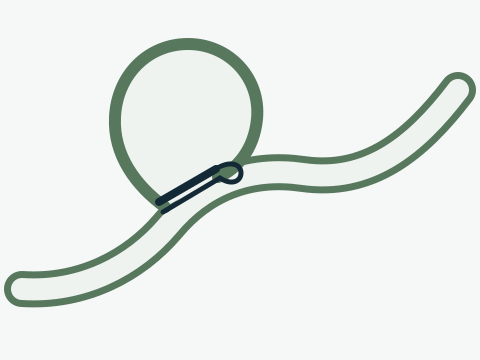
Through an opening in the skull, a small clip is placed across the aneurysm’s neck with the goal of keeping blood out of the bulge.

Through a catheter, soft coils fill the aneurysm from inside so blood no longer flows freely through the bulge.
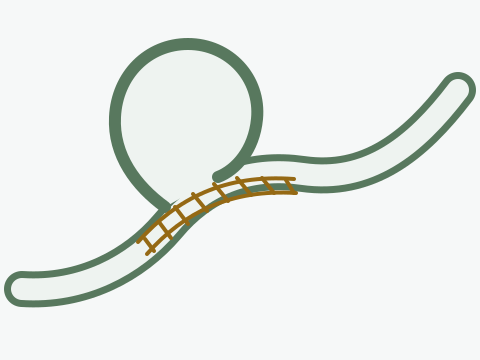
A fine mesh tube is placed in the parent artery across the aneurysm’s opening, redirecting blood along the artery.
Open treatment provides direct access to the aneurysm and surrounding anatomy, but it also involves an operation and recovery. Its suitability depends on factors such as location, shape, branch vessels, prior rupture or treatment, and the patient’s health. Possible complications and the expected recovery should be discussed for the specific operation being considered.
Endovascular treatment
Endovascular treatment reaches the aneurysm through a catheter placed in an artery, without opening the skull. Depending on the anatomy, techniques may include coils, stents, flow-diverting devices, or combinations of devices. Some devices require medication before and after treatment, which becomes part of the planning discussion.
Endovascular procedures also carry risks, including bleeding, vessel injury, stroke, and the possibility that an aneurysm will need continued imaging or additional treatment. Device choice and follow-up depend on the aneurysm’s shape, location, relationship to normal branches, and whether it has ruptured.
Why a combined perspective matters
Open and endovascular approaches are different tools rather than interchangeable answers. Some aneurysms are more readily addressed with one approach, while others require a close comparison or a staged plan. A team familiar with both perspectives can explain why a particular option is being considered and how its risks compare with observation and other treatments.
The goal of consultation is a decision grounded in anatomy, imaging, symptoms and history, age and health, and specialist judgment—not a claim that one technique is universally best.
Questions to bring to a consultation
When symptoms are an emergency
A sudden, severe headache—especially one that reaches maximum intensity quickly—can be a sign of bleeding around the brain. Loss of consciousness, new weakness or numbness, trouble speaking or seeing, a seizure, severe vomiting, or a sudden loss of coordination also requires urgent assessment. Call emergency services rather than driving or waiting for a routine appointment. This guidance cannot replace an emergency evaluation.
Brain aneurysm care is part of Dr. Oushy’s cerebrovascular practice, which spans both open surgical and endovascular treatment.
Terms used in this article
- catheter
- A thin, flexible tube guided through blood vessels to reach a treatment area.
- endovascular
- Treatment performed from inside the blood vessels, using a thin tube (catheter) guided through an artery or vein rather than an open operation.
- flow diverter
- A fine mesh tube placed in the parent artery across an aneurysm's opening so blood flows past rather than into the aneurysm.
- stent
- A small tube placed inside a vessel to hold it open or to support other devices.
- subarachnoid hemorrhage
- Bleeding into the space around the brain, most often from a ruptured aneurysm. It is a medical emergency.